Project overview

WFP’s nextgeneration, AI‑enabled geospatial targeting and vulnerability analysis system, transforming how WFP identifies and prioritizes vulnerable communities.

The challenge

Geographic targeting is the most common method used by WFP to identify areas and populations in most need of humanitarian assistance. Staff in WFP country offices responsible for conducting targeting are often constrained by administrative boundaries, scattered datasets and slow manual workflows. These limitations:

  • hide microhotspots of vulnerability,
  • force analysts into timeconsuming reconciliation of fragmented data,
  • increase operational costs for repeated field assessments,
  • lead to inclusion and exclusion errors,
  • delay crisis response and reduce programme impact.


GeoTar addresses these challenges by providing a unified, high‑resolution, AIpowered targeting engine built for speed, fairness and precision.

The solution

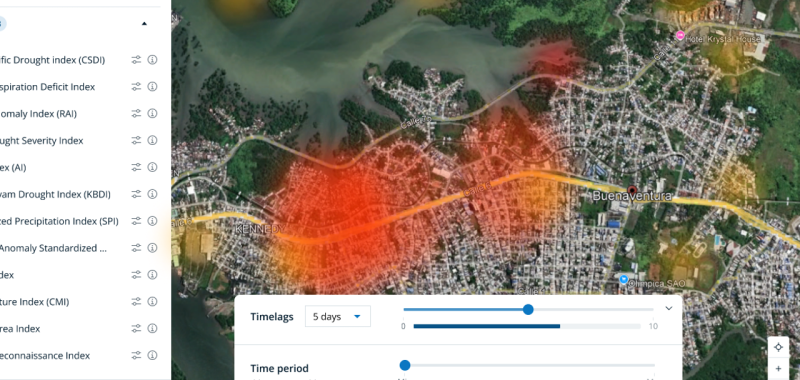
GeoTar is WFP’s next‑generation, AI‑enabled geospatial targeting and vulnerability analysis system, relaunched in 2025 to transform how WFP identifies which communities are most vulnerable and where support is needed most. It integrates food security data, climate patterns, market prices, displacement trends and satellite imagery and turns them into detailed maps. These high‑resolution maps (down to 1 km² or smaller) show important differences within districts that normal reports often miss. GeoTar is designed for staff in WFP country offices, regional bureaux and headquarters, helping teams make faster, clearer and more evidence‑based decisions, even when data is limited or situations change quickly.

The system pulls all relevant data into one place and uses machine learning to automatically produce updated vulnerability layers. These layers help WFP decide where to target assistance, set priorities and allocate resources more effectively. Tasks that previously took weeks of manual work can now be done in hours.
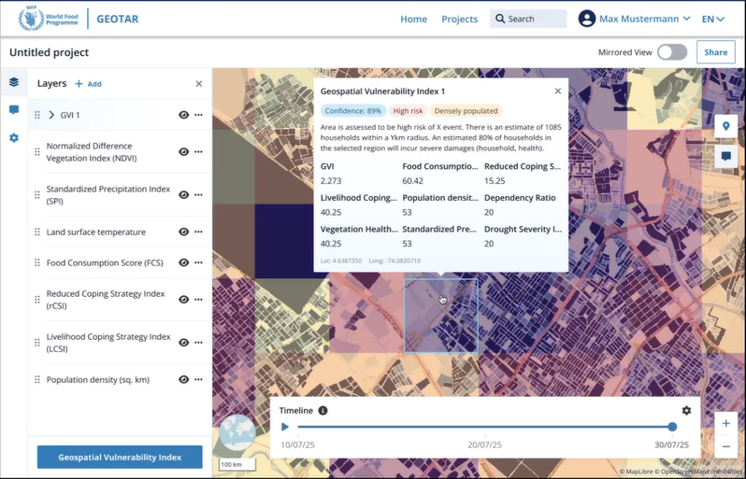
GeoTar map

GeoTar stands out because it shows detailed patterns and “hotspots” within districts that other tools overlook. It doesn’t rely on static assessments. Instead, it combines many data sources with predictive modelling, making decisions more consistent, transparent and timely. It also helps reduce mistakes, such as leaving out people who need assistance or including those who don’t.

Built to be enterprise‑ready, GeoTar integrates seamlessly with WFP systems and is designed to scale and work across many countries.


Results

GeoTar is in the development and integration phase, meaning all expected results are projections based on technical modelling, early prototypes and validated assumptions rather than achieved outcomes. Once fully deployed, GeoTar is expected to reduce analysis time by 97 percent - from 5–8 weeks (around 350 hours) to just 4–8 hours - and deliver cost savings of about USD 2.75 million per country office each year.

Working with the WFP Innovation Accelerator

The WFP Innovation Accelerator is supporting GeoTar through the Population Movement component, which focuses on using anonymized telecom mobility data to better understand displacement during crises.

Through the sprint programme, the WFP Innovation Accelerator provides operational access to the Cameroon country office for a real population‑movement use case, offers guidance to ensure the mobility‑data work meets WFP’s protection, governance and ethical standards, and supports data governance and compliance, including privacy safeguards and responsible data use. This support enables GeoTar’s population‑movement module to be tested in a real operational setting, helping validate its feasibility and value before integration into the wider system, and has enabled GeoTar to move from concept to a robust MVP now preparing for multi‑country pilot deployment.

Meet the team

Siddharth Krishnaswamy
Project owner, APPFA (Assessment & Targeting)
GeoTar logo
Edgar Wabyona
Project manager, PRGFA Targeting
Aysenur Ozcan
Product manager, Regional VAM Officer, APARO
Valerio Giuffrida
Technical lead, PRGFG Data & Systems
Paolo Lucchino
Technical lead, PRGFG Earth Observation
Paolo Baroni
Technical lead, TECDD IT Solutions
Last updated: 09/03/2026