

WFP works with thousands of schools around the world to help them provide a nutritious daily meal for millions of children in need. However, more than 80 percent of meals in WFP-assisted schools are prepared on rudimentary three-stone fires — which pose a serious threat to health, safety and the environment. Globally, 2.3 billion people lack access to clean cooking solutions, relying on burning biomass with negative socio-economic, health and environmental consequences.
Project overview
Carbon Credits Tanzania aims to create a replicable model, scalable through carbon financing, to improve food security, nutrition and health of low-income communities while protecting the environment by transitioning towards modern electric cooking.
Challenge
Solution
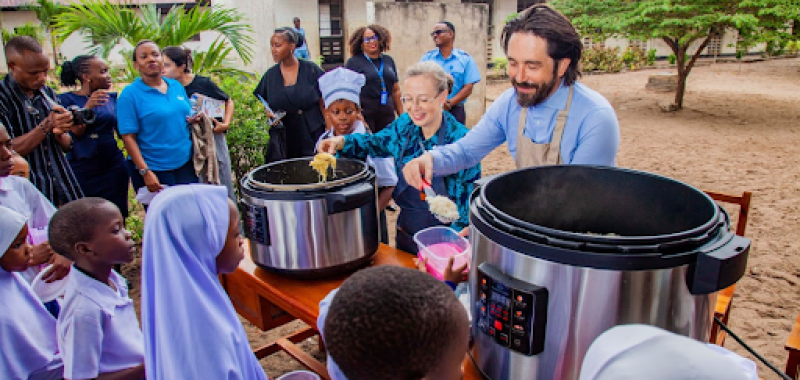
Through the Carbon Credits Tanzania initiative, WFP, Sustainable Energy for All (SEforALL) and Tanzania's National Carbon Monitoring Centre aim to provide electric cooking solutions in 50 grid-connected government primary schools. The initiative will promote local awareness and adoption at the local and national level, particularly empowering women through training on project implementation, energy audits and monitoring. Leveraging their role as platforms for innovation and transformational change, the primary schools will be the hub for the wider adoption of clean cooking solutions in the local community. It also aims to generate carbon credit revenue, which can then be reinvested in the initiative so it can sustainably scale.
Results
Carbon Credits Tanzania has begun implementation with the full transition of Kibasila Primary School in Dar es Salaam from firewood cooking to electric pressure cookers, demonstrating the feasibility of cleaner, safer, and more cost-effective electric cooking solutions in schools. Building on this success, the project is expanding to 36 additional schools, with kitchen refurbishments completed in Dar es Salaam and pressure cooker installations forthcoming, while refurbishment works are ongoing in Dodoma, Tabora, and Kigoma by the end of the first Quarter of 2026. As the project scales, it aims to reach 50 primary schools and approximately 50,000 students, achieving an estimated 20 percent reduction in cooking fuel costs and delivering measurable emissions reductions.
Meet the team
Raffaella Bellanca
Senior Energy for Food Security advisor global. WFP
Geoffrey Ndegwa
Energy for Food Security advisor Tanzania and southern Africa, WFP
Vera Kwara
Head of Nutrition and School Based Programmes, WFP
Mikael Melin
Head of People Centered Programmes, SE for All
Jee Hyun Nam
Clean cooking analyst, SE for All
Chifunhiro Mankhwazi
Youth analyst, SE for All
Last updated:
02/04/2026