


Nigeria has an estimated 2–3 million hectares of irrigation potential, yet less than 90,000 hectares are utilised. Fuel costs for fossil fuel-powered pumps can exceed ₦9,000 (USD 6.7) per day per hectare, making irrigation unaffordable for many smallholder farmers. As a result, farmers rely heavily on rainfall, limiting production to one season and increasing their exposure to drought, low incomes and food insecurity. Despite Nigeria’s abundant sunlight, high upfront costs and limited access to financing restrict the adoption of solar irrigation, preventing many farmers from achieving year-round productivity and greater climate resilience.
Project overview
Nimsy Agro Solar Concept’s solar irrigation pump combines lightweight, foldable solar panels with flexible financing to provide smallholder farmers with reliable, clean-energy irrigation. By reducing dependence on rainfall and expensive fossil fuels, it enables year-round farming, increases crop yields and incomes and strengthens food security and climate resilience.
Challenge
Solution
Nimsy Agro Solar Concept designs and deploys affordable, portable solar irrigation pumps that help smallholder farmers in Africa overcome the high cost of fuel-powered irrigation and dependence on rainfall. The solution enables farmers to grow crops throughout the year, increase food production, reduce irrigation costs, improve their incomes and become more resilient to climate change.
How it works
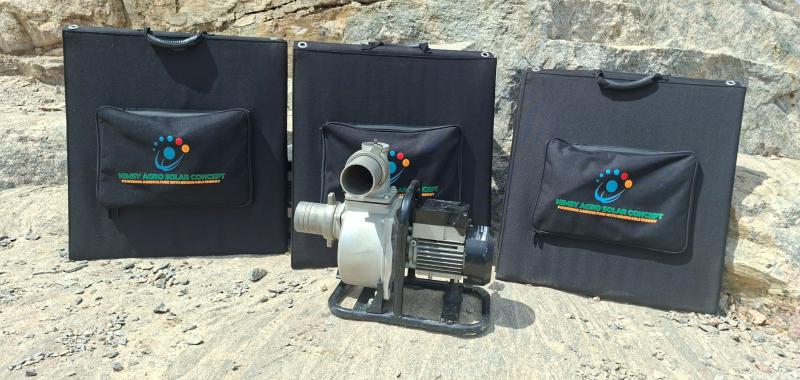
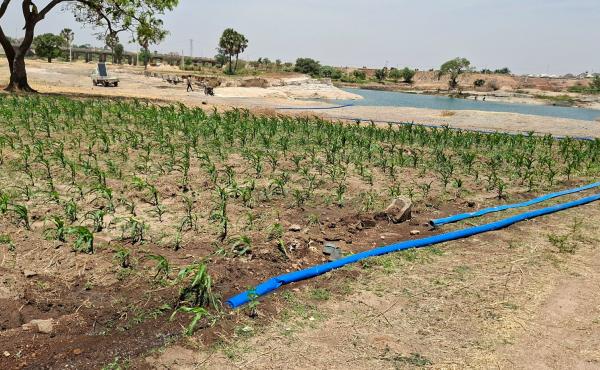
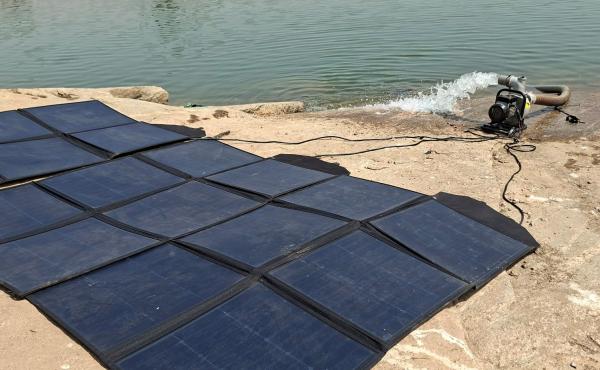
The solar irrigation system combines an energy-efficient water pump with lightweight, foldable solar panels that convert sunlight into electricity to pump water from rivers, streams, wells and other suitable water sources directly to farmland. Unlike conventional systems that use heavy, rigid solar panels, its foldable panels are lightweight, portable, easy to transport and simple to install. Farmers can fold, carry and relocate the system between farms without permanent installations or expensive infrastructure. The pumps come in different capacities suitable for smallholder farms ranging from approximately 0.5 to 4 hectares, making the technology adaptable to different farm sizes and irrigation needs.
What makes it unique?
This model goes beyond providing solar-powered irrigation equipment. It combines technology, affordable financing and last-mile distribution to address the main barriers preventing smallholder farmers from adopting irrigation.
- Foldable solar panels: The lightweight, foldable solar panels make irrigation equipment more portable, easier to deploy and less vulnerable to damage during transportation than conventional rigid panels. This is particularly important for smallholder farmers in remote communities or those cultivating multiple plots.
- Affordable lease-to-own financing: Recognizing that many smallholder farmers cannot afford the upfront cost of solar irrigation equipment, it offers a flexible Lease-to-Own model that allows farmers to acquire pumps with an initial deposit and spread the remaining payments over 18–24 months. This lowers the financial barrier to adopting clean irrigation technology.
- Community-based distribution and support: The team works with trained local agents who engage farmers, demonstrate the technology, facilitate equipment distribution, support repayment collection and provide basic technical assistance. This approach makes the technology more accessible to underserved rural communities while creating employment opportunities for young people.
The solar irrigation pumps also delivers economic and environmental benefits:
- Eliminate dependence on fuel, saving farmers more than ₦150,000 (USD 103) per month in fuel costs
- Increase crop yields and enable multiple planting seasons, helping farmers increase their incomes
- Reduce carbon emissions, supporting climate mitigation efforts
- Strengthen climate resilience by helping farmers adapt to erratic rainfall and drought.
Results
Nimsy Agro Solar Concept’s solar irrigation pumps are transforming smallholder agriculture in Nigeria by making affordable, clean-energy irrigation more accessible to underserved smallholder farmers. The solution enables farmers to cultivate crops two to three times a year rather than relying on a single rainy-season harvest, reducing irrigation costs, increasing food production and incomes and strengthening climate resilience.
Cumulative impact
- 12,000+ smallholder farmers reached across 11 Nigerian states through clean-energy agricultural solutions and rural engagement programmes.
- 2,000+ solar irrigation pumps deployed, helping farmers reduce their dependence on expensive petrol and diesel pumps.
- 73 young people trained in solar irrigation pump installation, maintenance and technical support, creating green employment opportunities.
Economic and agricultural impact
The solar irrigation pumps eliminate the recurring fuel costs associated with conventional petrol-powered irrigation, which can exceed ₦9,000 (USD 6.7) per day for farmers. Depending on usage, farmers can save approximately ₦150,000 (USD 103) per month on fuel, allowing them to invest more in seeds, fertiliser and farm expansion. Access to reliable irrigation also enables farmers to cultivate crops during the dry season, potentially increasing annual cropping cycles from one to two or three. This can improve agricultural productivity, create additional income opportunities and increase local food availability.
Environmental and climate impact
By replacing fossil fuel-powered irrigation pumps with solar technology, the solution reduces greenhouse gas emissions and supports cleaner agricultural production. Based on operational assumptions, deployed solar irrigation pumps have the potential to avoid approximately 4,092 tonnes of CO₂ equivalent annually, depending on actual use and the type of fuel-powered equipment displaced. Beyond reducing emissions, the solution helps farmers adapt to unpredictable rainfall, prolonged dry spells and other climate-related challenges by giving them greater control over water availability.
“Nimsy Agro Solar Concept’s solar irrigation pump has completely transformed my farming. I no longer depend on rainfall or spend money on petrol to irrigate my crops. I can now farm throughout the dry season and harvest twice a year, increasing my food production and income. The pump is reliable, affordable to operate, and easy to use.”
Ibrahim Musa Rice Farmer and Solar Irrigation Pump Beneficiary Nasarawa State, Nigeria
Last updated:
19/10/2026